

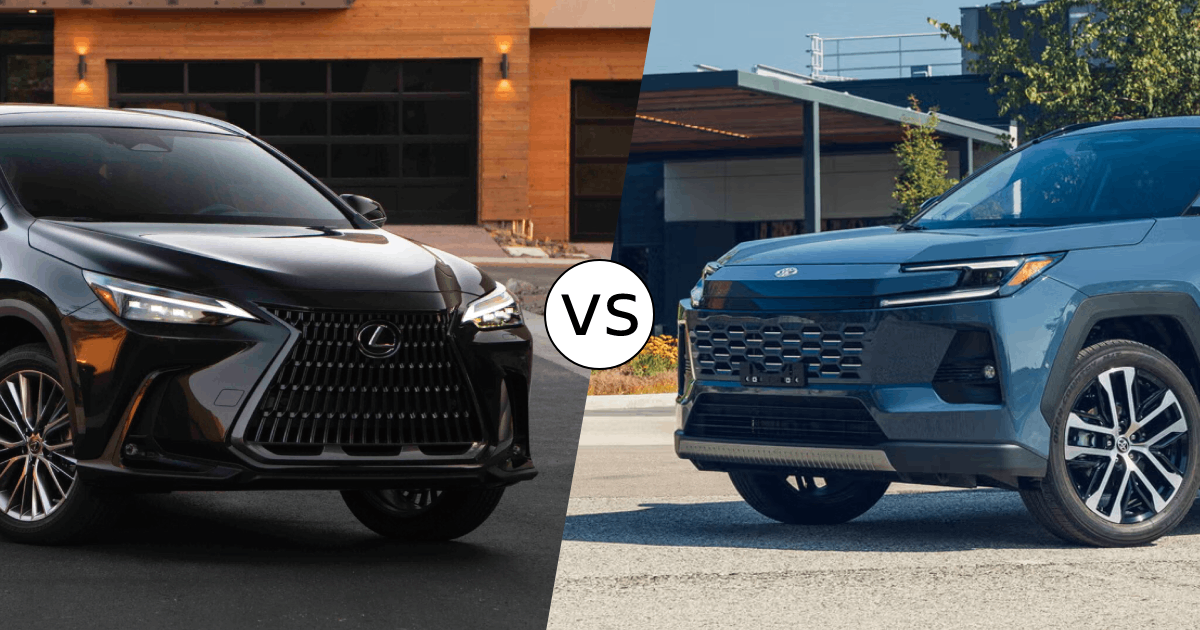
People ask all the time which Lexus compares to the RAV4, and the honest answer is the NX. Both SUVs share Toyota’s engineering DNA, but they serve very different buyers. The RAV4 is one of America’s most popular compact SUVs, built around practicality, efficiency, and accessibility. The NX is its luxury counterpart, trading some cargo space and sticker-price value for a more refined, feature-rich driving experience. If you’re weighing the 2026 Lexus NX against the 2026 Toyota RAV4, here’s what you actually need to know.
2026 Lexus NX vs. 2026 Toyota RAV4: Key Differences at a Glance
These two SUVs may share a parent company, but they occupy noticeably different spaces in the market. The NX offers powertrain variety and interior luxury across three configurations. The 2026 RAV4, by contrast, has moved to an all-hybrid lineup, putting fuel economy and electrification at the center of its identity.
| Category | 2026 Lexus NX | 2026 Toyota RAV4 |
| Powertrain Options | Gas (NX 350: 2.4L turbo I-4, 275 hp, 317 lb-ft), Hybrid (NX 350h: 2.5L I-4, 240 hp), PHEV (NX 450h+: 2.5L I-4, 304 hp) | All hybrid or PHEV (2.5L hybrid I-4: 226–236 hp; PHEV: 2.5L I-4, 324 hp) |
| Best Combined MPG | 40 MPG (NX 350h FWD) | 44 MPG (Hybrid FWD) |
| Cargo (Behind Rear Seats) | ~22.7 cu ft | ~37.8 cu ft |
| Towing Capacity (Max) | 2,000 lbs | 3,500 lbs |
| Infotainment Screen | Up to 14-inch touchscreen | Up to 12.9-inch touchscreen |
| EV Range (PHEV) | 37 miles (NX 450h+) | 52 miles (RAV4 PHEV) |
Interior quality tells a big part of the story here. The NX uses premium materials throughout the cabin, while the RAV4 keeps things functional with synthetic materials that hold up well for families. Safety tech differs in a meaningful way too: the NX brings more advanced driver assistance features at lower trim levels, while the RAV4 tends to reserve some of those for pricier configurations.
Powertrain Options: Gas, Hybrid, and Plug-In Hybrid Compared
Powertrain choice is one of the clearest ways to understand what separates these two. The RAV4 has fully committed to hybrid technology for 2026, dropping the gas-only variant entirely. The NX takes a different approach, offering three distinct paths.
2026 Toyota RAV4 Powertrains: All-Hybrid Lineup
Every 2026 RAV4 pairs a 2.5L four-cylinder with an electric motor via eCVT. The standard hybrid produces 226 hp in FWD configuration or 236 hp with AWD, the AWD system adding a rear motor. For buyers wanting extended electric capability, the RAV4 PHEV delivers 324 hp and 52 miles of EV range. Towing capacity ranges from 1,750 to 3,500 lbs depending on trim, and the standard hybrid reaches 60 mph in about 7.1 seconds.
2026 Lexus NX Powertrains: Gas, Hybrid, and PHEV Options
The NX 350 uses a turbocharged 2.4L four-cylinder producing 275 hp and 317 lb-ft of torque through an eight-speed automatic, hitting 60 mph in 6.6 seconds. The NX 350h hybrid pairs a 2.5L four-cylinder with an eCVT for a combined 240 hp. At the top sits the NX 450h+ PHEV at 304 hp with 37 miles of EV range. All NX trims are rated at 2,000 lbs towing capacity. The range of choices here genuinely accommodates drivers with different priorities.
Fuel Economy: Which SUV Is More Efficient?
On pure fuel economy, the RAV4 hybrid holds the edge. The RAV4 Hybrid FWD achieves 48 city / 42 highway / 44 combined MPG. The NX 350h FWD returns 40 combined MPG. That four-MPG gap in combined figures is consistent across FWD configurations and narrows somewhat with AWD on both models.
For Southern California drivers logging daily miles on I-10 or grinding through stop-and-go LA commutes, that efficiency advantage adds up to real savings over time. The NX 350 (gas only) rates 21 city / 28 highway MPG and requires premium fuel, which widens the cost-per-mile gap further. That said, the NX 450h+ changes the calculus for drivers who can charge regularly. Its 37 miles of EV range covers most local commutes without burning a drop of gas. The RAV4 PHEV pushes that advantage even further with 52 miles of EV range, rated at up to 40 MPG combined on gasoline.
Interior Space and Cargo Room: How They Stack Up
The RAV4 is the larger vehicle in practical terms, and the size difference shows up most clearly in cargo volume.
Passenger Space and Comfort
The RAV4 offers more rear legroom and a wider cabin, which matters for families or anyone regularly hauling adult passengers. Its ground clearance matches the NX at 8.1 inches, but its lighter curb weight (roughly 3,594 lbs for the LE hybrid versus about 3,945 lbs for the NX 350h) contributes to a more agile feel in tight spaces. The RAV4’s turning circle of 36.9 feet is also slightly tighter than the NX’s 38.0 feet.
The NX counters with a more polished passenger experience. Front seats are well-bolstered, cabin materials are a clear step up from the RAV4’s cloth and SofTex surfaces on comparable trims, and the NX cabin is specifically tuned to cut road and wind noise. If rear-seat space is the priority, the RAV4 wins. If interior quality matters more, the NX makes a compelling case.
Cargo Capacity and Everyday Usability
The RAV4 offers up to 37.8 cu ft behind the rear seats. The NX provides 22.7 cu ft behind the rear seats and 46.9 cu ft folded. That gap is substantial and directly affects day-to-day usability when you’re hauling gear, groceries, or larger family items. Buyers who need maximum cargo versatility will find the RAV4 far more accommodating. The NX does address its smaller footprint with a power liftgate and well-designed interior storage, but it does ask buyers to prioritize accordingly.
Technology and Infotainment Features
Tech is a genuine strength of the NX. The 2026 model comes standard with a 14-inch touchscreen, wireless Apple CarPlay and Android Auto, and a 12.3-inch digital gauge cluster on higher trims. Available features include a head-up display, Mark Levinson premium audio, and ambient lighting, and the system supports over-the-air updates.
The RAV4 tops out at a 12.9-inch touchscreen on higher trims and includes a 12.3-inch digital cluster standard across all trims, which is actually an advantage at the base level. Wireless Apple CarPlay and Android Auto are available, along with Toyota Safety Sense 4.0 and an available digital rearview mirror. Over-the-air updates are supported here too. For tech-focused buyers, though, the NX’s larger screen and available Mark Levinson audio deliver a noticeably more premium experience without needing to climb to a higher trim.
Safety Ratings and Driver Assistance Technology
Both SUVs come equipped with comprehensive driver assistance suites. The RAV4 is standard with Toyota Safety Sense 4.0, covering adaptive cruise control, lane tracing assist, automatic emergency braking, and pedestrian detection. Blind-spot monitoring and rear cross-traffic alert are standard across trims. The RAV4 is assembled in Canada or Japan depending on powertrain type.
The NX comes standard with Lexus Safety System+ 3.0, a comparable suite that adds proactive driving assist and intersection support. Blind-spot monitoring and rear cross-traffic alert are standard here as well. The NX is assembled in Japan. Both vehicles are expected to earn five-star NHTSA overall ratings based on prior model data, and either one is a strong choice for safety-conscious buyers and families.
Pricing, Value, and What Each SUV Delivers
The 2026 RAV4 enters at a lower price point with an all-hybrid standard lineup, making it one of the most accessible compact SUVs on the market. Its combination of fuel efficiency, cargo space, towing capacity, and strong reliability represents excellent value for buyers focused on practicality and long-term ownership costs.
The NX commands a premium, backed by real upgrades in materials quality, technology integration, powertrain variety, and overall cabin refinement. The NX 450h+ in particular makes a strong value argument for buyers seeking a plug-in luxury SUV with real-world efficiency and legitimate performance credentials. Which one is right for you comes down to which of those factors you weight most heavily.
Which SUV Is Right for You?
When customers ask us to help choose between these two, we start by asking what they prioritize daily. Here’s how the data maps to actual buyer needs:
- Buyers prioritizing cargo flexibility, lower entry pricing, and maximum fuel efficiency will find the RAV4 a strong fit.
- Buyers prioritizing cabin refinement, a larger infotainment screen, and powertrain variety (including a turbocharged gas option) will find the NX more aligned with their expectations.
- Buyers focused on PHEV range should note that the RAV4 PHEV offers 52 miles of EV range versus 37 miles in the NX 450h+.
- Buyers focused on towing will find the RAV4’s 3,500-lb maximum capacity significantly higher than the NX’s 2,000-lb ceiling.
If the NX sounds like the right fit, we invite you to browse our new Lexus inventory to see what’s available. If the RAV4 is calling your name, we’d encourage you to explore the 2026 RAV4 at Longo Toyota, our sister store. Both vehicles are exceptional in their own right, and the best decision is always the one that matches how you actually drive.
Connect with us


