

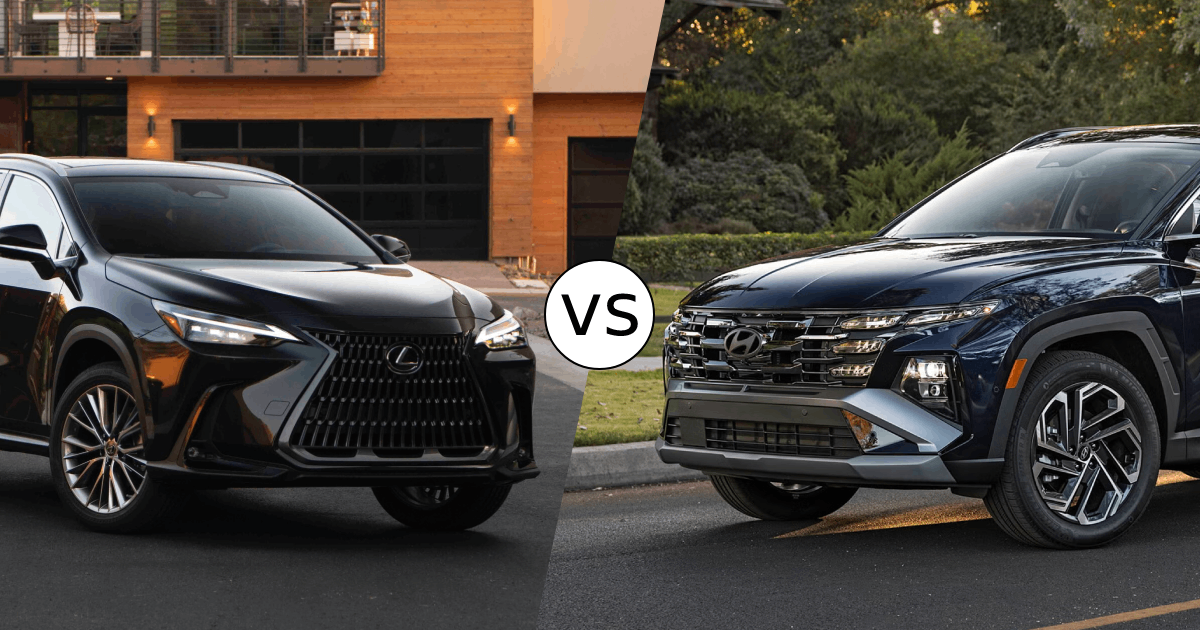
The Lexus NX and the Hyundai Tucson are two of the most sought-after models in the compact crossover SUV segment, and deservedly so. Both offer robust powertrains that elevate even the most ordinary commutes. They also come with many standard tech and comfort amenities, making every commute enjoyable.
But how do these rivals measure up against each other in 2026, and which should you buy? In this Lexus NX vs Hyundai Tucson buyer’s guide, we compare both vehicles in several key areas so you can decide for yourself.
Pricing and Trim Level Breakdown
The 2025 Lexus NX starts at a $42,260 MSRP for the base NX 250 model, with the Premium, AWD, and Premium AWD variants starting at $44,185, $43,860, and $45,785, respectively. The NX 350 trim begins at a $46,020 MSRP for the standard AWD model, while the Premium AWD, Luxury AWD, and F Sport Handling AWD start at $47,945, $52,085, and $50,630, respectively.
The hybrid 350 models begin at a $46,720 MSRP for the 350h AWD. Meanwhile, the Premium AWD and Luxury AWD variants start at $48,645 and $52,785, respectively. Lexus also offers two plug-in hybrid electric models for this model year: the 450h+ Luxury AWD and the 450h+ F Sport Handling AWD. The former starts at a $62,535 MSRP, while the latter begins at $63,635.
Similar to its rival, the 2025 Hyundai Tucson offers an extensive trim lineup, including gas, hybrid, and plug-in hybrid options. The base SE model starts at an MSRP of $28,705, with prices increasing as you move up the lineup. The highest-priced gas-powered model is the Limited, which starts at an MSRP of $38,645.
The 2025 Tucson’s hybrid line starts with the Blue trim, which has an MSRP of $33,465. Meanwhile, the top-of-the-line Limited hybrid begins at $41,295. For the plug-in hybrid choices, you have SEL, which starts at $39,730, and Limited, which starts at $47,440.
Performance and Powertrain Options
Both the 2025 Lexus NX and the Hyundai Tucson offer compelling engine options to match diverse driving preferences. Here’s what you get with each model in terms of engine specs and performance.
2025 Lexus Engine Choices
The 2025 Lexus NX is available with four engine options. The base NX 250 and its variants run on a 2.5-liter inline-four with an output of 203 horsepower. Paired with an 8-speed electronically controlled transmission, this engine delivers a quiet and responsive drive. Front-wheel NX models equipped with this powertrain complete the 0-60 mph sprint in just 8.2 seconds.
The 2025 Lexus NX 350 models come with a slightly more powerful 2.4-liter turbocharged engine, delivering 275 horsepower. Every NX 350 pairs the engine with an all-wheel-drive drivetrain and an 8-speed automatically controlled transmission for a nimble drive. As for acceleration, you can expect to hit 0-60 mph in about 6.6 seconds.
Standard on the NX 350h and its variants is a hybrid powertrain combining the 2.5-liter inline-four engine with Lexus Hybrid Drive, producing a net 240 horsepower. All models equipped with this powerplant pair it with all-wheel drive and an electronically controlled continuously variable transmission. They achieve 0-60 mph in 7.2 seconds.
The range-topping 450h models feature a plug-in hybrid setup that churns out a net combined 304 horsepower. All models with this system make the 0-60 mph dash in 6.0 seconds.
2025 Hyundai Tucson Engine Options
All 2025 Hyundai Tucson gas models are powered by a 2.5-liter inline-four engine producing 187 horsepower. Like the Lexus NX, the Tucson pairs this engine with an 8-speed automatic transmission. Front-wheel drive comes standard on all models equipped with this powertrain, while HTRAC all-wheel drive is optional.
Hybrid Tucson models use a hybrid system with a 1.6-liter inline-four turbo engine and an electric motor. This powertrain cranks out a net combined 231 horsepower and is paired with HTRAC all-wheel drive and a 6-speed automatic transmission. Plug-in hybrid Tucsons feature a plug-in variant of this setup, generating a net combined 268 horsepower. Like their hybrid counterparts, these models come standard with HTRAC all-wheel drive and a 6-speed transmission.
Fuel Economy and Real-World Efficiency
While the Lexus NX has a slightly more powerful standard engine than the Hyundai Tucson, the two are fairly matched in fuel economy. Both get EPA-estimated ratings of 33 mpg on the highway and 28 mpg combined in front-wheel configurations. However, the NX offers slightly better city economy at 26 mpg, compared to the Tucson’s 25 mpg.
That said, a clear difference emerges when comparing their hybrid models, with Lexus gaining the upper hand. Hybrid NX models achieve EPA-estimated ratings of 41 city mpg, 37 highway mpg, and 39 combined mpg. By comparison, Hybrid Tucsons are rated at 35 mpg in the city, 35 mpg on the highway, and 35 mpg combined.
Interior Space and Passenger Comfort
The 2025 Lexus NX and the Hyundai Tucson both offer comfortable seating for five. However, the Tucson has a slightly roomier cabin. It offers 40.1 inches of headroom in the front row and 39.5 inches in the rear, compared to the Lexus’s 38.3 inches in the front row and 38.5 inches in the rear. The Tucson’s legroom is also quite generous, with 41.4 inches in the front row and 41.3 inches in the rear. By comparison, the NX’s interior provides 41.0 inches of legroom in the front row and 36.1 inches in the rear.
The Tucson also edges out the Lexus NX in cargo volume. It offers 38.7 cubic feet with all seats in place and up to 74.8 cubic feet with the rear seats folded. The Lexus NX provides 22.7 cubic feet of cargo space behind the second row. Folding the rear seats brings the total cargo capacity to 46.9 cubic feet.
Which SUV Should You Choose?
The Lexus NX and the Hyundai Tucson are equally compelling SUVs, which makes deciding which to buy a daunting task. But getting behind the wheel and taking each for a spin can give you a better idea of which one suits your needs better. Contact Longo Lexus today to test drive the Lexus NX and experience its remarkable comfort and performance for yourself.
Connect with us


